
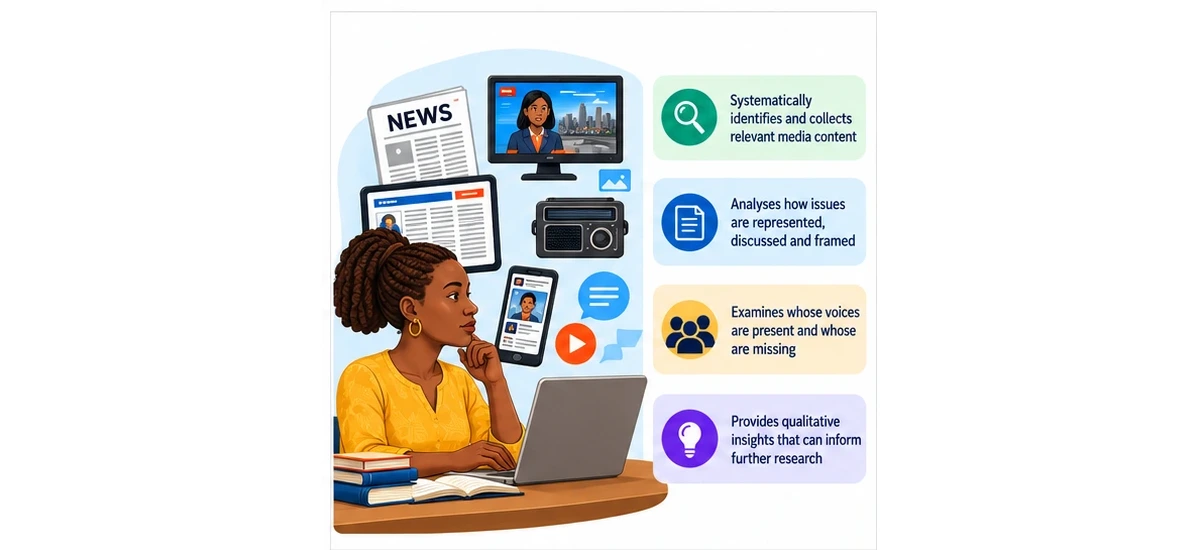
Media scanning is not just collecting news articles
Recently, I came across media scanning as a data collection approach. What caught my attention was that it can be a deliberate qualitative method for generating and analysing data, not simply a review of media coverage.
As always, my curiosity kicked in. I wanted to understand the method better. What exactly counts as media scanning? How is it different from simply searching Google for news articles? How do researchers decide what to include? And, perhaps most importantly, what can media scanning actually add to qualitative research?
After digging into it, one answer kept coming back: a pile of links is not yet a dataset. A research-quality media scan has a defined question, a documented search strategy, clear screening criteria, and a structured way of extracting and analysing what is found. This article walks through how that works, and why one of its most useful questions is not “what is being reported?” but “what is missing?”
So, what exactly is media scanning?
At its simplest, media scanning is a systematic process of identifying, collecting and analysing relevant media content around a defined topic, population, place or issue over a specified period.
The word “systematic” matters here. If I simply search for a topic, open a few articles, copy their links and write a summary, I am doing a search or informal desk review. That may be useful, but it is not necessarily a research-oriented media scan.
A structured media scan starts with a question, defines its scope, identifies relevant sources, uses documented search terms and criteria, records what is found, and then analyses the material in a way that can be explained and traced by another researcher.
A research-oriented media scan asks questions such as:
- What exactly are we scanning for?
- Which media sources are included, and why?
- What period are we covering?
- Which geographical areas are relevant?
- Which languages should be included?
- What search terms and combinations will we use?
- What makes an article relevant enough to include?
- What information will we extract from each article?
- How will we analyse the material?
Why might media be a useful qualitative data source?
Media can provide access to public narratives, debates, reported experiences, policy discussions, expert perspectives and emerging concerns. In some studies, it can also help researchers understand how an issue has been publicly constructed over time.
For example, if I am researching urban mobility, media coverage may reveal recurring discussions about transport affordability, safety, congestion, infrastructure, gender, accessibility or regulation. It may also help identify actors who repeatedly shape public conversations about these issues.
But there is an important methodological caution: media coverage tells us about how an issue is reported or represented. It does not automatically tell us how common that issue is in the population. A frequently reported issue is not necessarily the most prevalent issue, and an issue that receives little coverage is not necessarily unimportant.
Designing a media scan
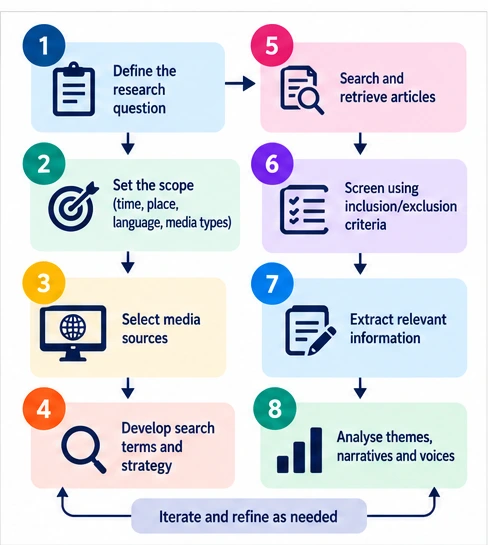
1. Start with a research question
The first step is not opening a browser. It is deciding what you want to understand.
For example:
- How is public transport safety represented in Tanzanian media?
- What concerns about food systems emerge in media coverage?
- How are communities represented in reporting about a development project?
- What narratives have emerged around a particular environmental policy?
The research question determines what you search for, what you collect and how you analyse it.
2. Define the scope
A media scan needs boundaries. These might include a time period, geographical area, language, media type and topic.
For example, a scan might cover Tanzanian media published between January and September 2026, focusing on English- and Kiswahili-language online news coverage of urban transport in Dodoma and Dar es Salaam.
3. Identify the media sources
Depending on the research question, sources might include newspapers, online news platforms, television, radio, news agencies and relevant media archives. Source selection should be documented rather than left to convenience.
Developing the search strategy
Search terms should be developed before the search begins, while allowing for refinement when the researcher encounters new terminology. This is especially important when working across English and Kiswahili, where the same concept may be described in several ways.
For example, a scan on urban mobility might use combinations such as:
- "public transport" AND Tanzania
- daladala AND Dodoma
- ("urban transport" OR "public transportation") AND women AND Tanzania
- usafiri wa umma AND Dodoma
- daladala AND wanawake
Keeping a record of the searches matters. If I later find 80 relevant articles, I should be able to explain where they came from and how I identified them.
Screening: what gets included?
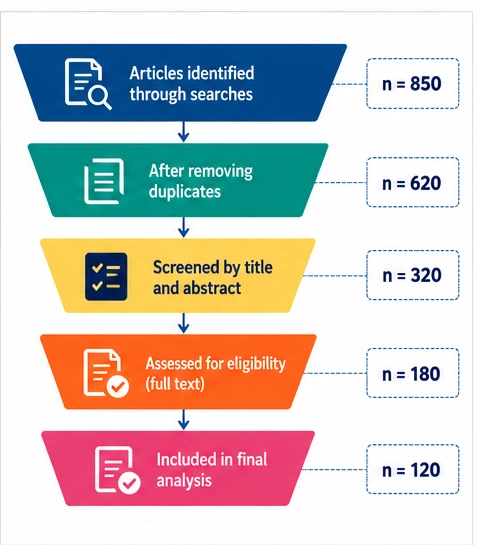
Not everything returned by a search belongs in the dataset. This is where inclusion and exclusion criteria become useful.
Possible inclusion criteria:
- Published within the defined study period.
- Substantively discusses the topic of interest.
- Falls within the defined geographical scope.
- Appears in a source included in the search strategy.
- Possible exclusion criteria:
- Duplicate or syndicated items where the same content has already been captured.
- Articles that only mention the topic incidentally.
- Content outside the geographical or temporal scope.
- Promotional or commercial material, where inappropriate to the research question.
What do we actually extract from an article?
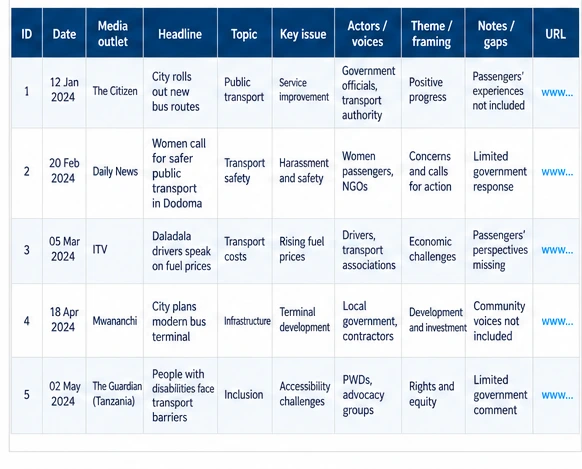
This is where a media scan begins to look much more like a qualitative dataset. Rather than simply saving links, the researcher extracts comparable information from each item.
| Field | What it captures |
| Date | When the item was published |
| Media outlet | Who reported it |
| Headline | How the issue is initially presented |
| Topic / issue | What the article is substantially about |
| Actors | Who is mentioned or quoted |
| Voices | Whose perspective is represented |
| Theme | Recurring issue or concept |
| Framing / narrative | How the issue is presented or constructed |
| Evidence | What evidence or sources are used |
| Gaps | What appears absent or underrepresented |
| URL | Source and traceability |
The question I find most interesting: Who is missing?
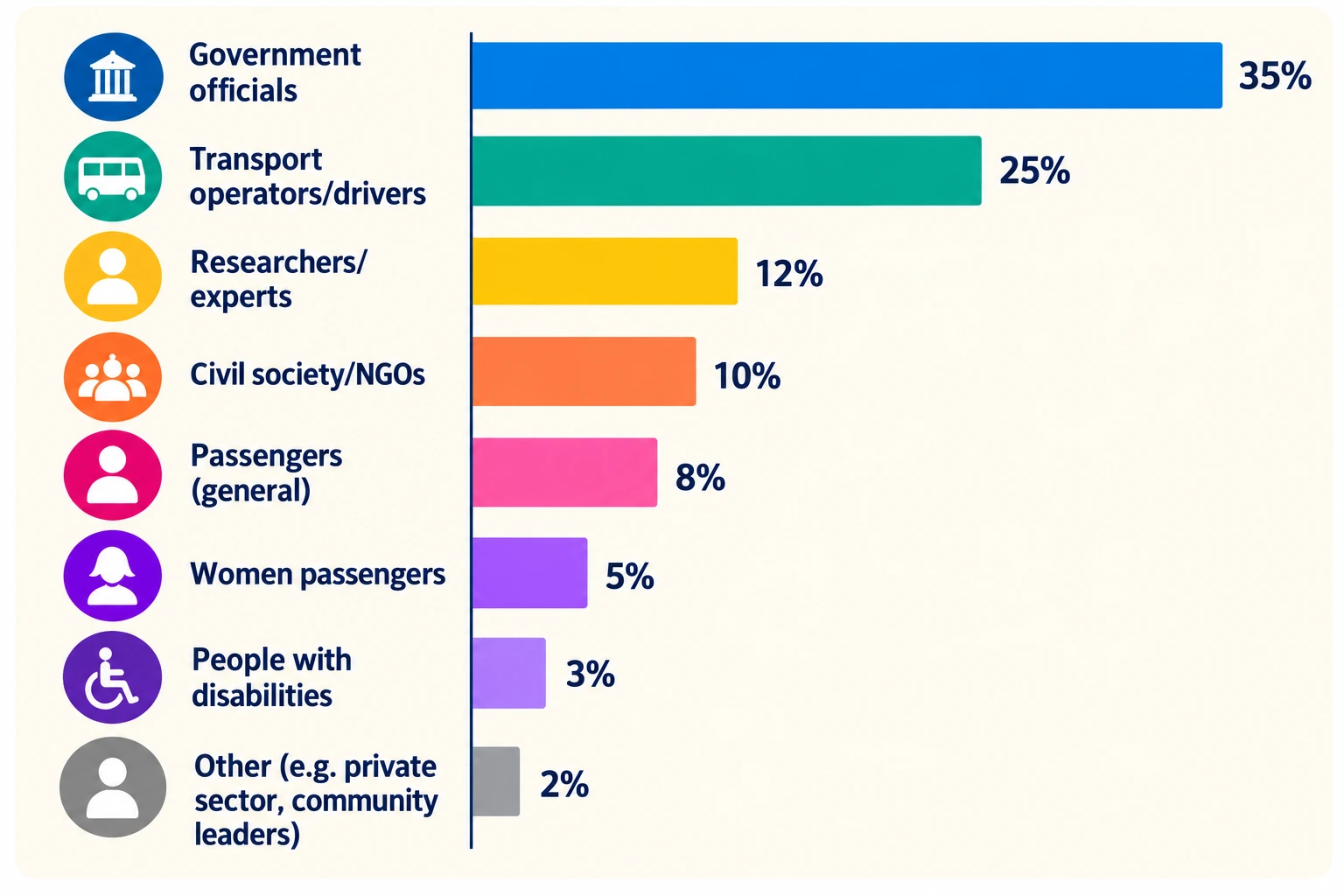
One of the things I find particularly interesting about media scanning is that the analysis does not have to stop at what is visible. We can also ask who is not visible.
Imagine that a media scan identifies 20 articles discussing public transport affordability. Government officials are frequently quoted. Transport operators appear regularly. Researchers are occasionally included. But passengers themselves rarely speak, and women passengers are almost absent.
That absence is analytically interesting. It does not mean that women passengers have no views or experiences. It may instead tell us something about whose voices are more likely to enter public media and whose voices are less visible.
This distinction is important: absence from media coverage is not evidence that a group has no perspective. It may be evidence about the structure of public representation.
How do we analyse media content?
The analytical approach should follow the research question. A researcher might use thematic analysis to identify recurring themes, framework analysis to code material against predefined categories, narrative or framing analysis to examine how an issue is constructed, or stakeholder and voice analysis to examine who speaks, who is spoken about and who is absent.
The goal is not simply to count articles. Counts can be useful for describing the dataset, but qualitative analysis asks what the patterns mean.
How can media scanning inform primary research?
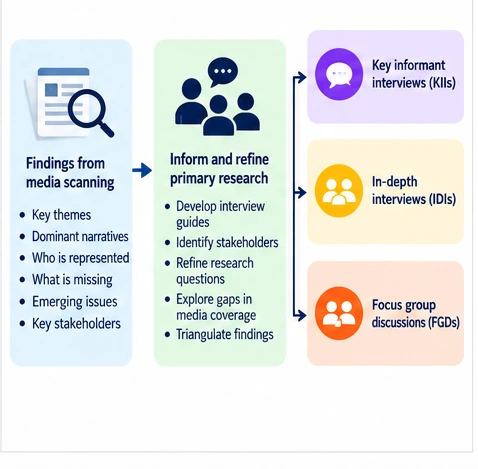
This is where I see media scanning fitting particularly well with formative and qualitative research. It can be used before or alongside interviews, focus group discussions, key informant interviews, observation or other methods.
A media scan can help researchers:
- Identify emerging themes.
- Identify relevant stakeholders.
- Understand public narratives around an issue.
- Identify contested or sensitive topics.
- Develop or refine interview and discussion questions.
- Identify gaps that primary research should explore.
- Triangulate findings from other data sources.
For example, suppose media coverage repeatedly discusses transport affordability but says little about how affordability differs by gender, income, employment or travel purpose. That does not give us the answer. But it gives us a useful research question.
We can then take that gap into IDIs, FGDs or KIIs and ask people about their actual experiences.
But media scanning has limitations
Like every research method, media scanning has limitations. Media organisations have editorial priorities. Some groups have greater access to journalists than others. Some events receive disproportionate attention. Search engines do not necessarily return a neutral sample of everything that has been published. Articles may also be duplicated or syndicated across outlets.
Language is another consideration. A scan conducted only in English may produce a different picture from one that includes Kiswahili coverage. Similarly, a scan of online media may miss relevant radio or television content, particularly where transcripts or archives are not easily accessible.
These limitations do not make the method weak. They simply need to be acknowledged and incorporated into the study design.
Ethical considerations
Publicly available information is not automatically free of ethical considerations. Researchers should think carefully about quoting individuals, reproducing identifiable information, reporting on vulnerable populations, and taking statements out of their original context.
Where media content includes personal information or sensitive experiences, the researcher should consider whether reproducing that information is necessary for the research purpose and whether doing so could cause harm.
A simple media-scanning workflow
- Research question
- Define scope
- Select sources
- Develop search terms
- Search
- Screen
- Extract
- Code
- Analyse
- Identify patterns and gaps
- Use findings to inform the wider research
A simple media-scanning matrix
A basic extraction matrix might look like this:
| ID | Date | Source | Headline | Topic | Actor | Voice | Theme | Framing | URL |
| MS001 | 15 Sept 2026 | Media outlet | Headline | Transport | Official | Passenger | Safety | … | … |
Where I see media scanning fitting in qualitative research
I can see media scanning being useful across many of the areas where qualitative research is already helping us understand systems and lived experience: public health, food systems, environmental research, urban mobility, policy research, community development and social and environmental assessments.
I would not see it as a replacement for interviews, FGDs, observation or participatory methods. Rather, it can add another layer to the picture.
Sometimes the question is not only, “What are people experiencing?” It is also, “How is this issue being discussed publicly?” and “Whose experiences are making it into that public conversation?”
Where this leaves us
Looking back, I have found myself asking: "How would I have used media scanning in some of the research projects I have conducted?" As a formative and multisectoral researcher, I can see it adding value to many development and intervention projects.
One example is my work contributing to a World Bank Group study supporting the Dodoma Integrated and Sustainable Transport (DIST) Project, on promoting gender equality and decarbonisation in Dodoma's urban transport.
Alongside the literature and document review that informed our design, a media scan could have added another layer: how transport in Dodoma is publicly discussed, which institutions and operators are quoted most often, and whether women's experiences of safety, cost and access appear at all. Those gaps could then have shaped our KII, IDI and FGD guides and helped us decide whose voices to prioritise in the field.
A media scan will not tell you how common an issue is, and it will not replace interviews, FGDs or observation. What it does is show you how an issue is being talked about publicly, who is speaking, and who is not.
If you are planning formative research, it is worth asking early: what would a media scan add to this design?
0 Comments