
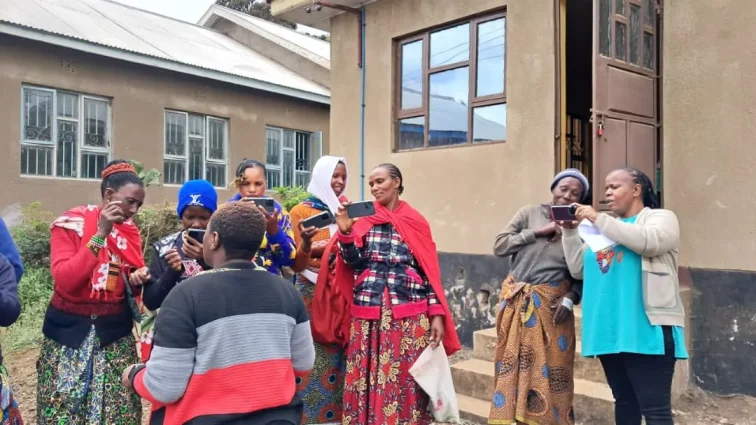
Of every participatory action research (PAR) method I have used, Photovoice is still the one I would choose first. Not because it produces good photographs, but because it is one of the few methods that does not let a researcher hide behind the role of observer.
It Was Never Designed to Just Collect Data
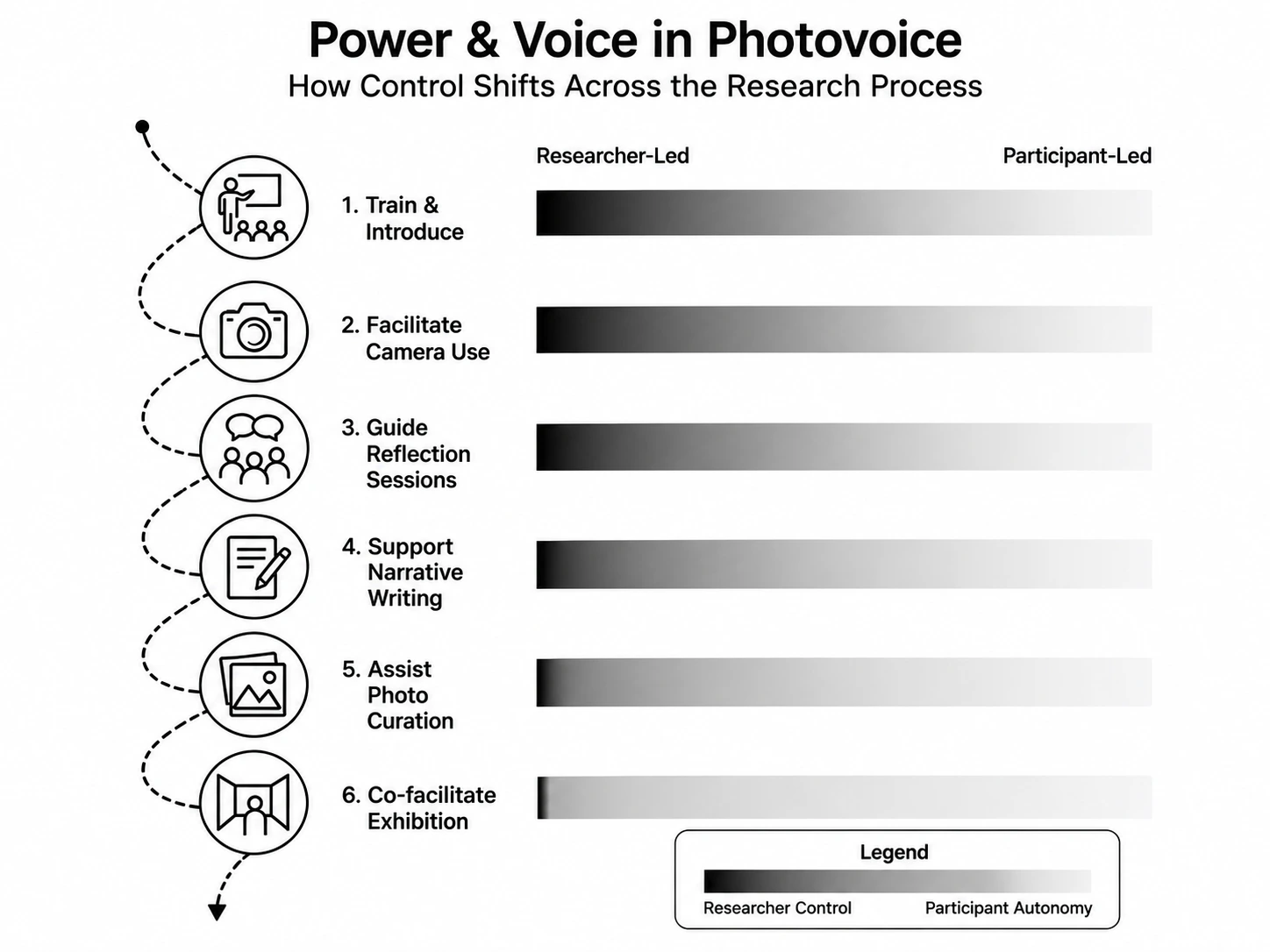
Photovoice sits inside participatory action research (PAR), and more specifically inside participatory visual methods; the same family as photo-elicitation, video diaries, and participatory mapping. That placement matters because Photovoice changes how participants are invited to represent their world.
Many conventional qualitative methods require participants to translate their experiences into questions, categories, and representational formats largely established by the researcher. That does not make these methods inherently extractive, but it can leave the researcher with considerable control over what becomes visible, what is interpreted, and what ultimately reaches decision-makers. Photovoice shifts more of that representational work toward participants themselves.
Caroline Wang and Mary Ann Burris developed Photovoice in 1997 as a participatory approach intended not only to document community realities, but also to create critical dialogue and bring community-generated concerns to policymakers (Wang & Burris, 1997).
Its intellectual foundations are commonly associated with Paulo Freire’s concept of critical consciousness and feminist approaches that foreground lived experience, voice, power, and representation (Freire, 1970; Wang & Burris, 1997).
That is why Photovoice is often described as an empowerment-oriented or advocacy method. It has also been used to document and interpret experiences of gender-based violence (GBV) including how violence is experienced, normalized, resisted, and understood within particular social contexts.
A qualitative systematic review found that Photovoice has been increasingly applied in gender-based violence research, demonstrating its broader relevance for exploring sensitive and socially situated experiences (Christensen, 2019). This is another reason it sits uneasily under the label “data collection instrument” in the narrow sense of an interview guide.
In practice, Photovoice brings together three connected elements: photography as data generation, structured group dialogue (commonly using the SHOWeD framework) as a way of interpreting and discussing the images (Wang, 1999), and opportunities to share findings with policymakers or programme decision-makers.
The strength of the method is not simply in producing photographs, but in creating a participatory process through which people can generate evidence, interpret what it means, and potentially bring that evidence into conversations about decisions that affect them.
That structure is what makes Photovoice unusual. It can shorten the distance between doing research and acting on it, rather than treating advocacy or policy engagement as something that happens only after the research is complete.
It is also why I keep returning to it in gender and disability inclusion work, and in environmental and resettlement contexts. Those are exactly the settings where affected people, including non-literate participants, need a direct evidentiary voice in how their situation gets documented.
This also connects with a principle I have encountered in work on Free, Prior and Informed Consent (FPIC). Photovoice and FPIC are not equivalent: FPIC is a rights-based process concerning consent, decision-making, and the authority of communities over decisions affecting them. But they share an important refusal, to treat communities merely as sources of information while interpretation and consequential decisions remain elsewhere.
Where I Tested That Claim: Arusha's Food Environments
I ran and supported Photovoice workshops over a six-month consultancy supporting the Fruit and Vegetables for Sustainable Healthy Diets (FRESH) Initiative at the World Vegetable Center, as part of a study on food environments in Arusha Region (de Bruyn et al., 2024).
The study deliberately paired two contrasting communities: Kiwawa, a peri-urban settlement with about 115 food retail outlets mapped within it, and Shiboro, a rural community with just 12. That contrast wasn’t incidental; it was the sampling logic. If access, price, and food safety pressures look different in a market-dense peri-urban setting versus a land-based rural one, the food environment framework needed both to say anything useful about either.
The research sequence itself tells you something about where Photovoice sits in a mixed-methods design. We didn’t open with cameras. Thirty vendors and ten consumers were interviewed in-depth first, to map the terrain of the food environment in their own words. Only then did a sub-sample of ten vendors and ten consumers move into participatory photography; people who had already been heard once, now being asked to show what talking hadn’t fully captured.
My contribution sat across both stages. I translated key study documents, contributed to refining the interview guides and workshop guides, and managed field logistics and relationships with local leaders; the unglamorous groundwork that decides whether a study can actually happen in a given community. I personally conducted more than 20 of the in-depth interviews, across vendors and consumers of different ages, genders, and circumstances, which meant adjusting register and pace constantly rather than running one script twenty times.
The part that shaped how I think about the method, though, was co-leading the Photovoice workshops with fellow researcher Dada Lydia Mukasa and our supervisor Dr. Julia De Bruyn: running the initial participatory training sessions, providing one-to-one follow-up support to participants as they went out and photographed their own food environments, and facilitating the small group discussions where those images were unpacked.
Watching the Third Stage Actually Happen
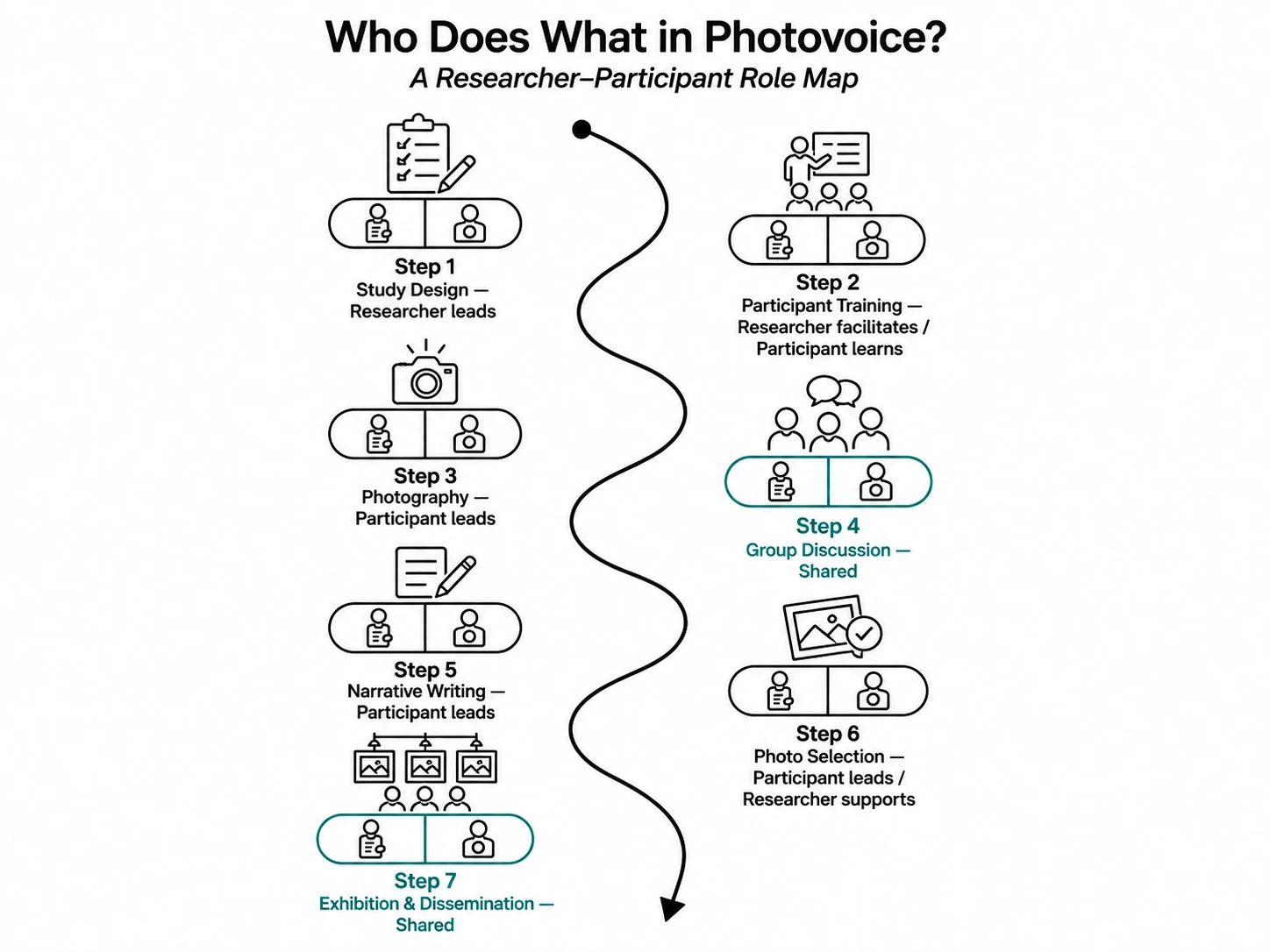
The reason I keep insisting Photovoice isn’t “just” a visual method is that I watched all three of its stages play out in sequence, and the third one (creating a credible opportunity for findings to reach and influence decision-makers) is where many qualitative studies become weaker. The problem is not that qualitative methods cannot inform action; it is that the pathway from interpretation to action is often treated as something external to the method, to be handled later by someone else.
Findings from the interviews and the Photovoice sessions were synthesised into an interactive ArcGIS StoryMap, built in both English and Kiswahili, and presented at a multi-stakeholder workshop in December 2024, attended by government trade and nutrition officers from Arusha City and District Councils, market chairpersons from Ngaramtoni and Tengeru, agricultural researchers, NGO representatives, and, critically, original research participants themselves.
Four of those research participants (one vendor and one consumer from each community) sat on a panel and spoke directly to the room using images they had personally selected from their own Photovoice sets: one photograph representing a challenge, one representing a motivation. The challenge images carried poor transport and market infrastructure, mobility barriers, worry about pesticide residues, and the unpredictability of seasonal supply. The motivation images carried home gardens, a preference for traditional leafy vegetables, and vendor-consumer relationships built on trust rather than a single transaction.
Those images, and the thematic analysis built from their captions, fed directly into the four themes the workshop worked through: food safety, access variation, financial barriers, and vendor-product linkages. From there came a working set of recommendations: agricultural extension support for safer pesticide use, investment rather than vendor self-funding for market infrastructure, and nutrition messaging grounded in what people had actually shown, not what a survey instrument had assumed they’d say.
That is the collapse I mean when I say Photovoice refuses to stay a data collection tool. The photographs a vendor took of her own stall didn’t end as an illustration in a report. They ended as the evidence a district trade officer was responding to, in the same room, in the same afternoon.
From Policy Implication to Implementation
Getting evidence into a room with policymakers is not the same as getting it implemented. But the method still matters at that stage.
When recommendations are grounded in evidence that participants have helped generate, interpret, and present, implementation starts with a different understanding of the problem. The question is no longer only, “What intervention should we introduce?” It becomes, “What is already happening here, what constrains people, what resources exist, and what would need to change for this recommendation to work?”
That distinction matters in applied research. A recommendation about market infrastructure, for example, is different when it comes from a policy review alone than when vendors have shown the transport, mobility, safety, and financial constraints they navigate every day.
The method cannot guarantee implementation. What it can do is make the evidence behind a decision more grounded, more visible, and harder to detach from the realities that implementation will have to confront.
I am not arguing that every qualitative study should use Photovoice. Different research questions require different methods. I am arguing for something more basic: choose methods not only for how well they generate data, but for what they allow people to see, say, interpret, and act on. If the research is intended to inform policy or implementation, that pathway should be considered at the design stage, not added after the findings are already written.
What makes Photovoice distinctive is not that other qualitative methods cannot be participatory, ethical, or action-oriented. They can. Its distinctive contribution is that it builds a more visible and direct route between participant-generated evidence, collective interpretation, public presentation, and the people who may be able to act on it.
The Pattern Underneath the Projects
I notice the same underlying instinct showing up whenever I look back across the fieldwork I have done since Arusha, even in projects that never touch a camera.
On the OVERDUE Sanitation project in Mwanza, we used shadowing and trajectory. We shadowed sanitation workers and traced trajectories and transect walks, following how people actually move through the sanitation landscape over time: who cleans, who maintains, who fixes, and at what cost. No interview guide captures that as honestly as watching it unfold. Trajectories showed us how inequalities in access get reproduced or addressed over years, not just in a single moment of “access” or “no access.” Shadowing showed us the invisible labour (mostly women’s) that keeps informal sanitation systems functioning at all.
On the Community Carbon Project in Manyara Region, my role was documenting and facilitating the FPIC process through Village Assemblies and Ward Development Committee meetings across the participating villages. Photographs were involved as evidence, but not in the same way as on Photovoice. FPIC was fundamentally about rights, consent, participation, and community authority over decisions affecting them. The shared methodological concern was to ensure that community perspectives were not reduced to information collected for interpretation elsewhere.
On my recent involvement with the World Bank Group’s Dodoma transport project, nearly all of the fieldwork was qualitative (FGDs, KIIs, observations, and ride-alongs) precisely because a transit gap analysis built only from ridership counts would have missed why women avoid certain bajaji routes at certain hours, a finding that only surfaced because people were asked to narrate, not just tabulate.
Across all four (Arusha, Manyara, Mwanza, Dodoma) the constant isn’t the technique. It is a refusal to let the research sit at a remove from the people it’s about.
Photovoice just makes that refusal structural, because the method can create a direct route for the community’s own selected evidence to reach the people with power to act on it.
Participation Has a Cost
Photovoice is not necessarily the cheapest qualitative method to implement. The costs are not limited to the cameras or smartphones. They include participant training, airtime, follow-up visits, facilitation, workshops, transport, and the logistical preparation required to support participants while they are generating and discussing images.
Participants can use their own phones, but in some research settings it may be preferable to provide dedicated devices for the Photovoice exercise. That means additional procurement and planning.
That matters methodologically. If participation is central to the method, then the resources required to make meaningful participation possible cannot be treated as optional extras.
You cannot budget for the camera and under-budget the participation.
What I Take From This Into Every Study Since
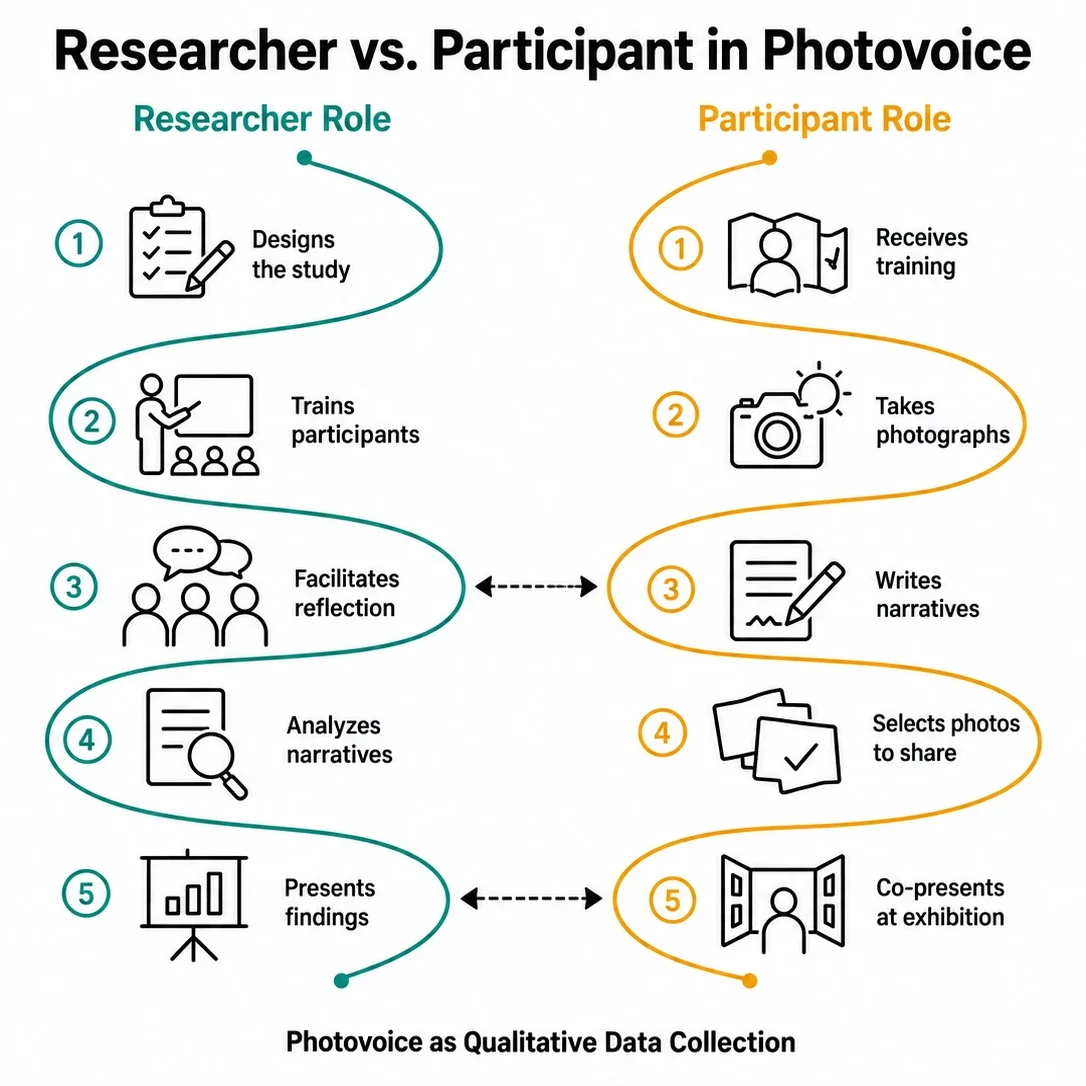
The lesson I keep applying, well beyond Photovoice itself, is that a method’s power is not exhausted by its data collection instrument. It also lies in whether the research design creates a credible route from evidence to the people who can act on it, and whether that route runs through the community’s own framing or around it.
Some qualitative studies stop at interpretation and leave the “so what now” to someone else, later, in a different room. Photovoice makes that separation harder to maintain. As the researcher, you remain in the room, watching each person express themselves through their own photographs, and that is precisely the discomfort (and the value) that the method is designed to hold you in.
Photovoice is not automatically ethical simply because participants hold the camera. Visual methods raise their own questions: Who appears in the image? Has consent been obtained from identifiable people? Who owns the photographs? Who controls where they are displayed or circulated? Can participants withdraw an image after it has been shared?
Participant-generated evidence still requires careful attention to privacy, safety, dignity, ownership, and the consequences of visibility. The method redistributes some control over representation, but it does not remove the researcher’s ethical responsibilities.
References
Christensen, M. C. (2019). Using Photovoice to address gender-based violence: A qualitative systematic review. Trauma, Violence, & Abuse, 20(4), 484-497.
de Bruyn, J., Msangi, S., Mukasa, L., & Gordon, J. (2024). How can food environments support greater fruit and vegetable consumption in Tanzania? A multi-stakeholder workshop to share findings and co-develop recommendations for interventions in Arusha Region. World Vegetable Center.
Freire, P. (1970). Pedagogy of the oppressed. Herder and Herder.
Wang, C. (1999). Photovoice: A participatory action research strategy applied to women’s health. Journal of Women’s Health, 8(2), 185-192.
Wang, C., & Burris, M. A. (1997). Photovoice: Concept, methodology, and use for participatory needs assessment. Health Education & Behavior, 24(3), 369-387.
0 Comments