
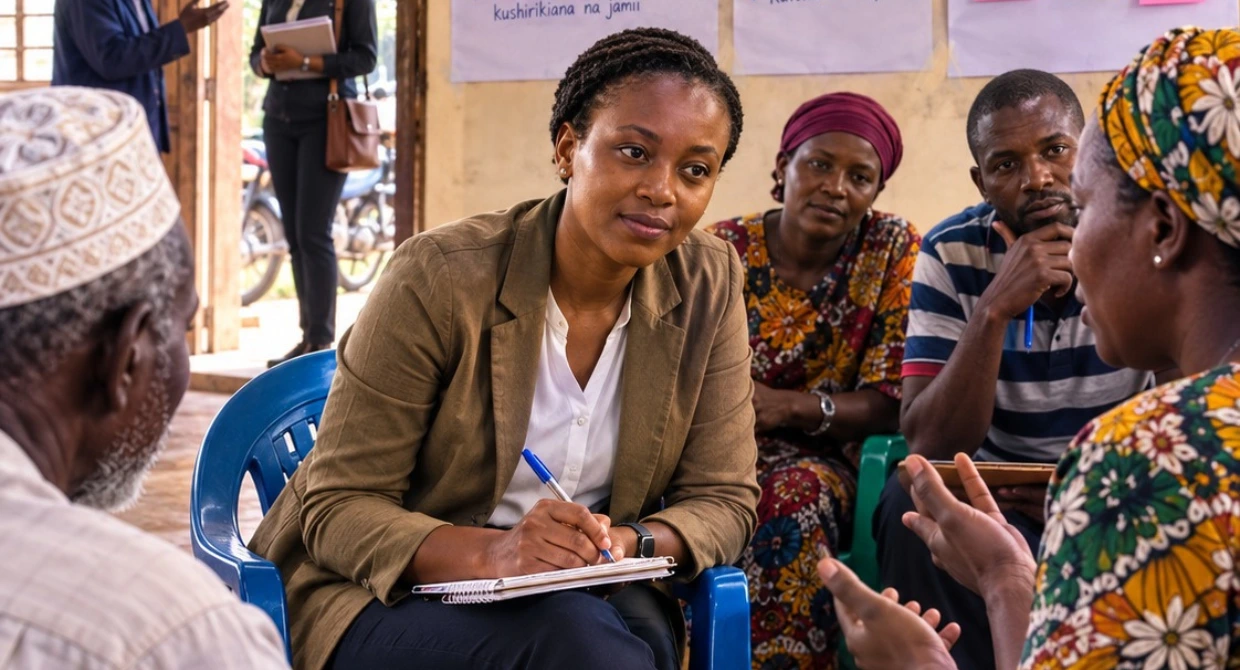
Most guidance on qualitative fieldwork starts with the discussion guide: the questions, the sampling, the analysis plan. Good fieldwork starts upstream of that, with entry and facilitation, because that is where the guide either gets used well or never gets the chance to.
Most field projects do not fail in analysis. They fail before the first question is ever asked.
Entry Is Not Administrative. It Is Methodology.
I have seen a carefully designed study (ethics approval in place, tested tools, a clear protocol, logistics arranged) struggle because the team arrived in a community that had no reason to trust them, no clear understanding of why they were there, and no meaningful opportunity to decide whether they wanted to participate.
I remember arriving for a focus group discussion in field site X and finding the venue empty. Not because participants had failed to come; they were outside waiting.
The community elder had not been consulted, the local government official had not been informed, and the logistics were ready, but the relationships were not.
I did not start the group. I sat with the elder and the villagers who were present, explained the purpose of the research, answered questions, listened to concerns, sought his blessing, and returned the following day. With time and patience, I earned my place of welcome.
That experience reinforced something I now treat as foundational: community entry is not an administrative step before "real" data collection. It is part of the methodology.
Good entry depends on a few things that are easy to underestimate:
- Engaging local gatekeepers and understanding how legitimacy works in that setting
- Explaining the research honestly, without hiding behind technical language
- Seeking genuine consent and social approval, not simply signatures
- Learning the local context before arrival; its history, power structures, language, relationships, and unspoken rules
These are not extras. They determine access, trust, participation, and ultimately the integrity of the evidence.
I once watched a colleague lose patience during a community engagement session that had gone off-script, with participants raising grievances that seemed unrelated to our research objectives. He leaned over and said: “These people don't know what they are talking about.”
I pulled him aside: “Whatever they are saying in there, that is the data.”
Beneath the tension was a history we had arrived too late to witness, and within that history was exactly the contextual knowledge qualitative research exists to surface.
Entry Looks Different Depending on Who Holds the Gate
The elder in field site X is one version of a gatekeeper. He is not the only version, and treating "entry" as a single fixed skill undersells how much it has to adapt to where you are working.
On the DIST project I am currently working on, the gatekeepers were not village elders. They were bajaji and bodaboda association leaders, market and terminal leaders, and institutions such as the Ministry of Health, LATRA (the land transport regulator), TARURA (the rural and urban roads agency), TANROADS (the national roads agency), and City Council.
Getting a female bajaji driver to talk about safety decisions on specific routes depended on the same underlying skill as the village elder did: recognising who actually held legitimacy in that space, before assuming the research team automatically did.
A terminal has its own hierarchy, its own unwritten rules about who speaks for whom, in the same way a village does. The form of the gatekeeper changes. The requirement to find and respect it does not.
The same held on the World Vegetable Center's food environment (FRESH) project in Arusha and Singida. There, entry meant something closer to relationship-building with individual vendors and consumers ahead of in-depth interviews and Photovoice workshops.
These were people with no formal association to negotiate through, only their own willingness to be observed and photographed talking about their food environment.
Three different projects, three different kinds of gatekeeping. The same principle underneath all of them: you do not get to decide you have earned access. The community, the terminal, or the individual participant decides that, and the research has to wait for it.
Once You Are in the Room, the Moderator Is the Instrument
Entry gets a team into the room. What happens next depends on something a discussion guide cannot supply on its own: the skill of the person holding it.
Two teams can use the same discussion or interview guide, with similar participants, in similar settings, and walk away with very different data. The difference is made in real time; in how the moderator listens, probes, manages silence, handles dominance, notices discomfort, protects neutrality, and builds enough trust for people to say something they had not planned to say.
I was reminded of this during fieldwork on a project I won't name here. Some of the recruited facilitators had limited prior research experience. Once our field coordinator recognised this, I was asked to take on additional responsibilities to help protect data quality, and I accepted.
It reinforced something I have learned repeatedly in the field: a research instrument can be technically excellent and still produce weak evidence if the person using it cannot read the room.
Weak moderation rarely looks dramatic. The questions are technically correct, but the probe arrives too early. A participant says something difficult, and the moderator moves on instead of gently staying with it.
One or two confident voices dominate while quieter participants disappear. Silence becomes uncomfortable, so the moderator fills it before meaning has had time to surface. Sensitive topics are approached too quickly, without the cultural care they require.
The session finishes on time, the transcript exists, and the report gets written, but the depth never arrives.
Skilled moderation looks different. It means probing deliberately; from description to meaning to implication, and sometimes from individual experience to the systems shaping it. It means balancing power, gender, age, confidence, and language within the group.
It means remaining neutral enough that participants are not subtly pushed toward the answer the researcher expects, while noticing what is emerging analytically and staying fully present as a facilitator. Sometimes it means knowing when to stop asking and start receiving.
That is why FGD (focus group discussion) moderation is not a soft skill or an entry-level task. It is methodological work. And once a weakly facilitated conversation has happened, you cannot return to the field and collect the same moment again.
The Work Between the Sessions
Entry and facilitation are the visible parts of the process. What holds them together is almost never visible at all.
A methods section can make research look deceptively tidy: “Data were collected between March and June.” That sentence hides an entire world.
It hides the field coordinator rebuilding trust after a misunderstanding nearly ended access. The researcher rewriting a plan because a community meeting moved by two days. The enumerator who notices on day two that a key question is being interpreted differently across the team.
The 9 PM call to a ward official to secure a venue for the following morning. Field notes written late at night before boarding an early daladala with a recorder in one hand.
I have learned this through the unglamorous parts of field research: long travel, changing schedules, limited connectivity, understaffed teams, community expectations, and the constant need to make decisions without compromising the quality or ethics of the work.
Sometimes that means moderating and note-taking simultaneously because the team is short-staffed. Sometimes it means recognising a problem while still in the field, rather than discovering it during data cleaning. Sometimes it means rebuilding trust after a communication failure, or staying curious when exhausted.
None of this is a complaint. It is a reminder that evidence does not emerge from protocols alone. It is produced through hundreds of small decisions made by people working inside real systems with real constraints.
Why This Matters for How Fieldwork Gets Commissioned
For anyone designing or budgeting a qualitative study, three layers determine whether the resulting evidence is trustworthy, and each is routinely under-resourced:
- Entry needs time and local relationships built in before data collection starts, not folded into the same week as fieldwork. It needs to be scoped separately for each type of gatekeeper the project will face; a village elder, an operators' association, or an individual participant with no formal representation at all.
- Facilitation needs experienced moderators, not simply enough hands to run a schedule, a facilitator's skill is not interchangeable with a facilitator's availability.
- The connective labor (logistics, trust repair, real-time quality checks) needs to be staffed and budgeted as part of the method, not absorbed as an invisible cost that field teams simply carry.
None of this shows up as a line item. But treat entry and facilitation as methodology rather than logistics, and the difference isn't a smoother project. It is evidence you can actually act on.
The Standard
If the data matters, the moderator matters, the entry matters, and the person managing the 9 PM calls matters. Every published paper has a polished methods section.
What it cannot show is how much of the evidence depended on the people who carried the study through the moments when the protocol met reality. That is not the inconvenience between the protocol and the publication.
That is where the evidence is made, whether the gate you are standing at belongs to a village elder, a terminal association leader, or a single person deciding whether to trust you with their story.
0 Comments